

Challenge: Balancing the need for a fully custom designed wedding website with the ease of use for admins and fast development.
Solution: Building a frontend React and Next.js and connecting it to Starhive as the backend and admin panel.
Impact: A stunning, personal wedding website built in just a few days. Without needing to develop the admin panel, Erik estimates he was able to create the website in around a third of the time.
Wedding websites are standard these days. But for frontend developers, the usual providers don't offer the control they desire over the design and functionality. So many opt for building their own from scratch, an often stressful endeavour at an already stressful time.
About Erik

Erik Nilsson, frontend developer at Starhive and former graphic designer, decided to build his own website, but decided to speed up development by using Starhive as the backend.
How to balance control with usability
Platforms like The Knot and Hitchd are brilliant for couples without web development experience to build websites to manage RSVPs, curate registries, and provide information to their guests. But for developers, their templates are often restrictive and lack flexibility. Erik wanted full customisation and the ability to add unique features for guests and family but to do so, he would need to use Supabase or Firebase as the backend.
This is fine for developers, but Erik's fiancé is not a developer. For her to manage guest data and chase missing RSVPs, Erik would need to build an admin panel, adding extra tedious work to the build.
Supabase and Firebase interfaces are terrifying for non-developers. The language is technical and each action feels drastic. I didn’t want to be a bottle neck for finding out who still hasn’t RSVP’d or if Nathalie is still a vegetarian.
He needed a solution that could manage guest data securely, support a custom frontend, and stay intuitive enough for non-technical users to update information on their own.
Enter Starhive, an intuitive, user-friendly backend
Being part of the Starhive team, Erik already knew its capabilities as a backend-as-a-service platform, primarily for asset management, and saw an opportunity to test its limits. Instead of tracking laptops or machines, Erik configured a Starhive workspace for tracking guests and RSVPs in about 30 minutes. The system stored all essential information such as guest names, emails, addresses, food preferences, and RSVP statuses.
Development of the frontend took a few days using React + Next.js before spending another 30 minutes connecting it to the Starhive backend. Once complete it was hosted on Vercel and shared with their guests.
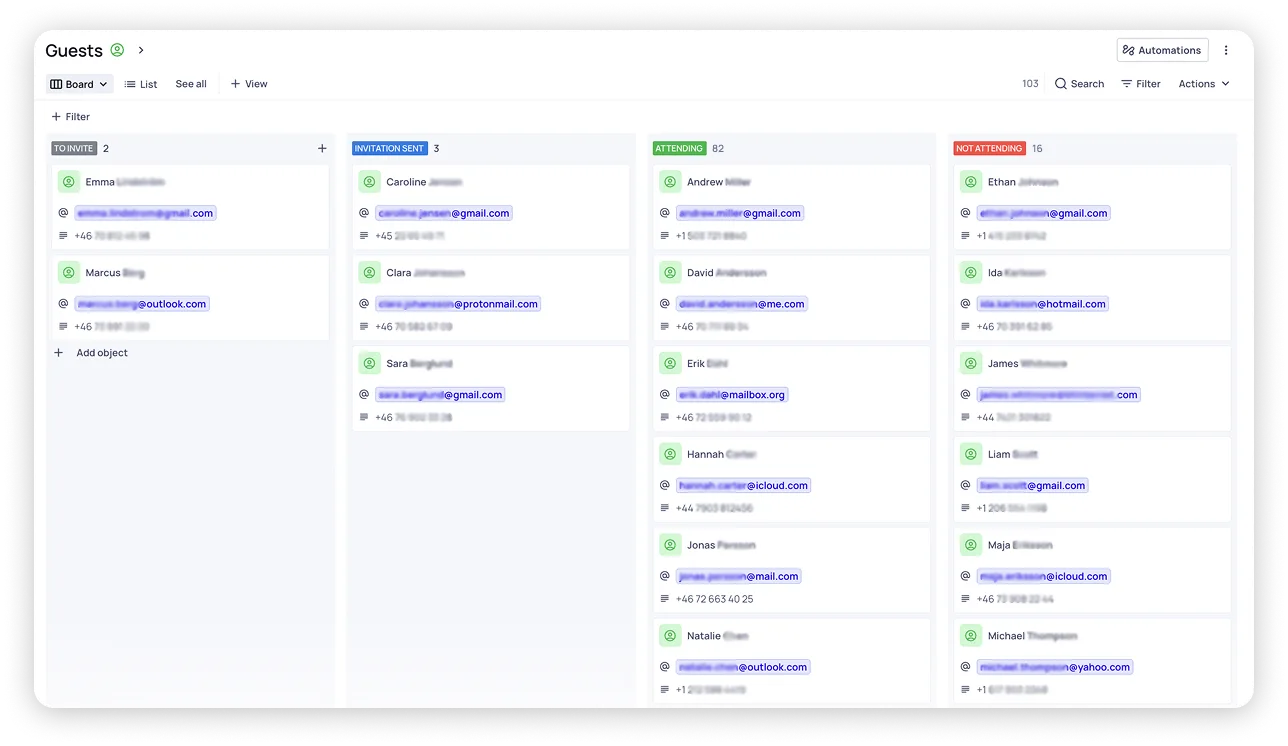
Thanks to Starhive’s features such as search filters and automation, basic features could be implemented in minutes such as:
- Simple board view to track RSVP status
- An interface where his fiancé could make manual updates
- Automatic thank-you emails triggered when RSVPs were received
When inspiration struck, extending the data model was just as easy.
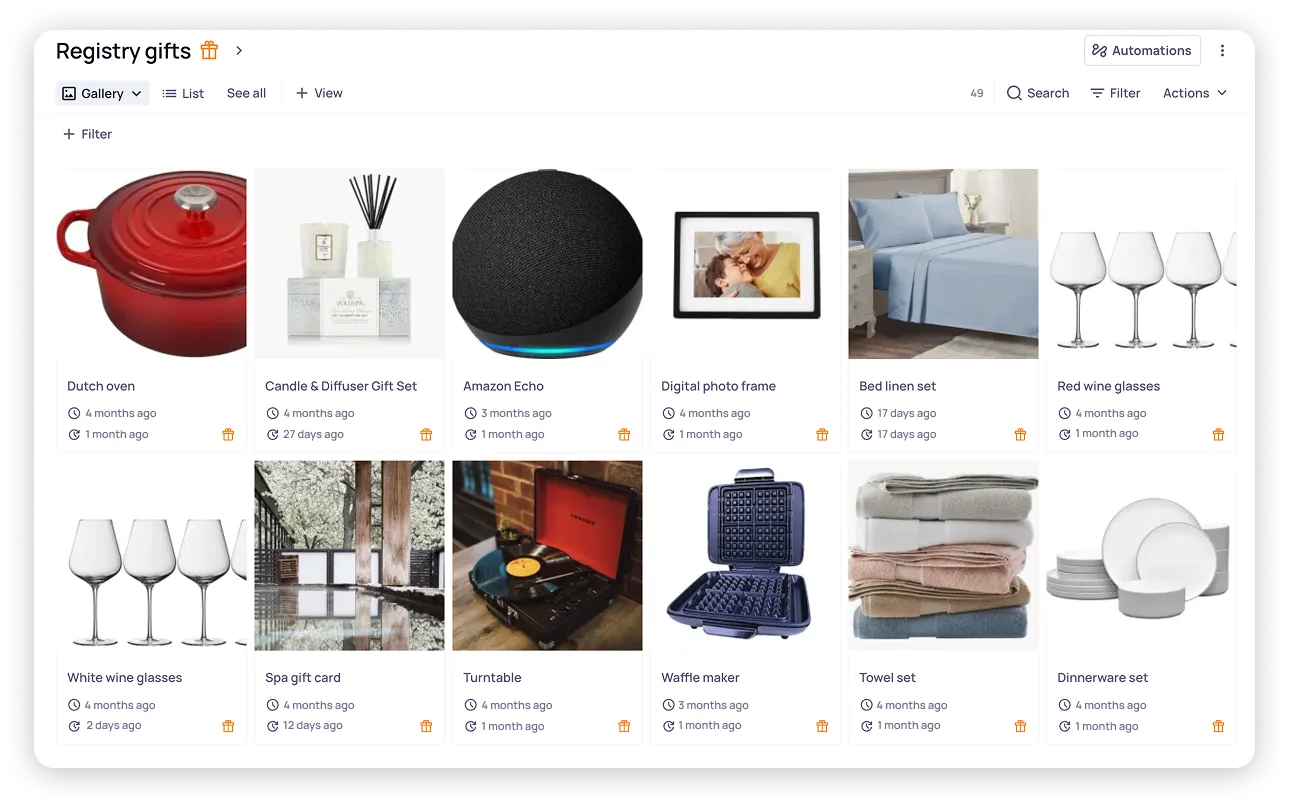
I later added a gift registry by creating a ‘Gifts’ type in Starhive with a picture, price, link, and purchase status. From idea to production it took just a few hours.
A stress-free, well-organised celebration
In less than three days of total development time, the site was live and fully operational. Without needing to code the admin panel capabilities at all.
Creating an admin panel would have been way too much work. Easily double what it would take to make the user facing side. There's so many more requirements for making an admin panel. Logins, connecting even more endpoints to the backend, tables. Just not a fun time
Starhive's existing interface acting as the website backend made it simple for both partners to stay on top of planning, track RSVPs in real-time, manage guest details without confusion, and update the gift registry as needed.
My wife was a Starhive pro within the first week. She was filtering undefined RSVP statuses and chasing people down like the Terminator.
The result? A perfectly coordinated wedding, complete with accurate guest data. No surprise guests. no food hiccups, and one very happy couple. Nathalie had the fish, if you were wondering, and it was delightful.